<?xml version="1.0" encoding="UTF-8"?>
<?xml-stylesheet href="transform-to-html_v0.4.28.xsl" type="text/xsl"?>
<html xmlns="http://www.w3.org/1999/xhtml">
<head>
          <title>Defsystem UG (haftungsbeschränkt)</title>
          <link rel="icon" href="/favicon.ico" type="image/x-icon"/>
          <link rel="shortcut icon" href="/favicon.ico" type="image/x-icon"/>
          <meta property="og:title" content="Defsystem UG (haftungsbeschränkt)"/>
          <meta property="og:description" content="Defining connected systems. We design sensor systems and IoT devices. We realize proofs of concept, prototypes and minimum viable products (MVPs)."/>
          <meta property="og:type" content="website"/>
          <meta property="og:url" content="https://www.defsystem.net"/>
          <meta property="og:image" content="http://www.defsystem.net/images/defsystem-logo-sq.jpg"/>
          <meta property="og:image:secure_url" content="https://www.defsystem.net/images/defsystem-logo-sq.jpg"/>
          <!-- more headers for html rendering -->


	</head>
<body>
  <article class="post featured">
    <header class="major">
      <span class="date">Feb 23, 2024</span>
      <h2>Kombucha sensor system by Defsystem</h2>
      
      <p>This was our first sensor system using uLisp® in Feb. 2021.
      It is a software-defined sensor system that monitors the PH level and liquid temperature while brewing Kombucha.</p>
    </header>
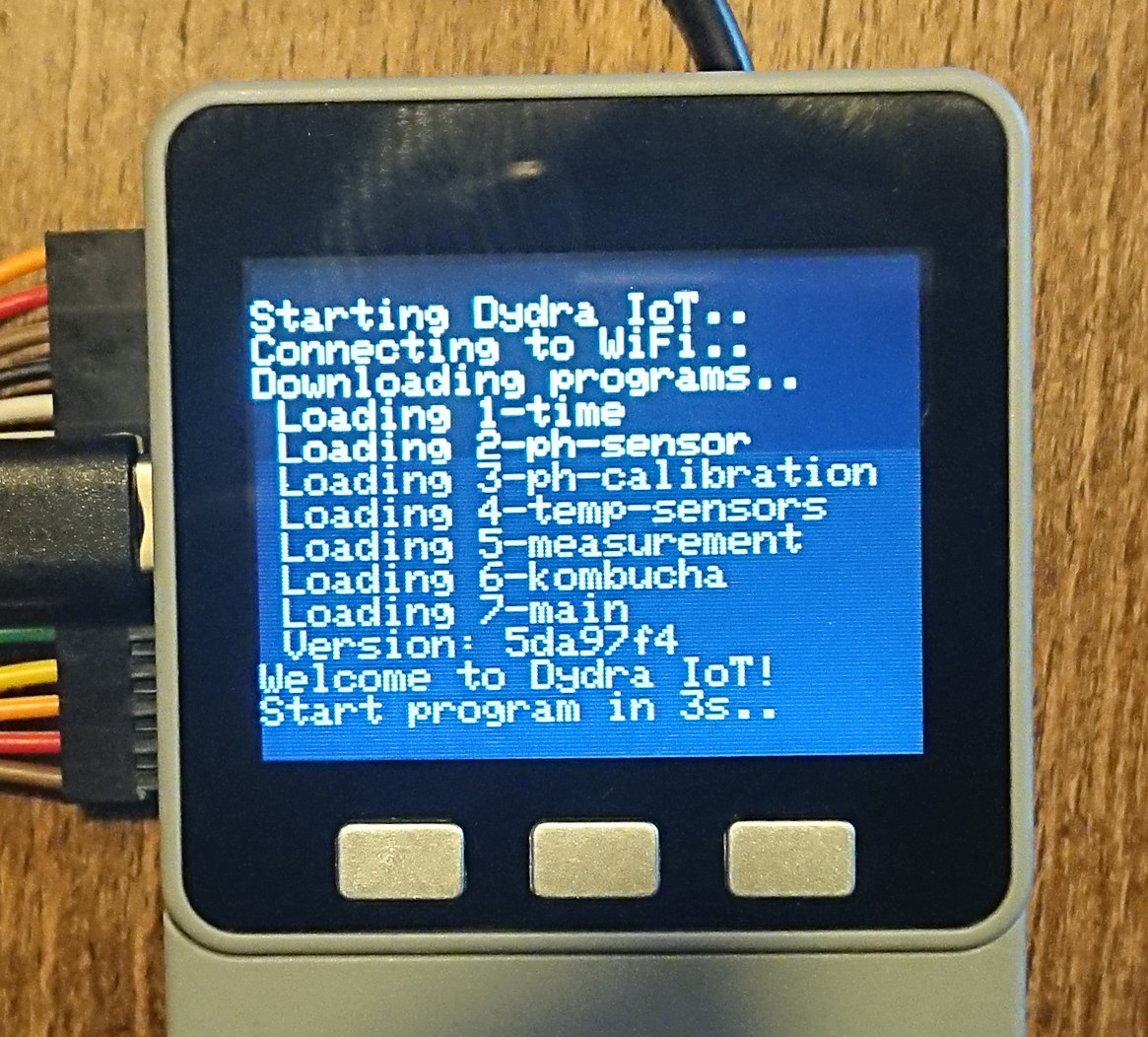
    <a class="image main"><img src="images/Kombucha-IoT-System/DSC_1491s_kombuchaboot.jpg" alt="Kombucha IoT System by Defsystem"/>This software-defined sensor system downloads its user application securely from the Internet when it starts up.</a>

    <p>
      Technically this first system predates Defsystem as a company,
      but it was done by the founder of Defsystem and started our
      journey into sensor systems.
    </p>
    
    <!--
        Kombucha sensor device \hfill Max-Gerd Retzlaff, Feb. 2021
        Kombucha-IoT-System/DSC_1489s_kombucha-setup.jpg
        Kombucha-IoT-System/DSC_1491s_kombuchaboot.jpg
        Kombucha-IoT-System/DSC_1492s_kombuchastarted.jpg
        Kombucha-IoT-System/DSC_1493s_kombuchacalibration.jpg
        Kombucha-IoT-System/DSC_1496s_kombuchasut.jpg
        Kombucha-IoT-System/DSC_1497s_kombuchameasure.jpg
        Kombucha-IoT-System/DSC_1497s_kombuchameasure.jpg
        Kombucha-IoT-System/DSC_1447s_kombucha-black.jpg
        Kombucha-IoT-System/dydra-fbfpt-cr.jpg
        Kombucha-IoT-System/observable-dydra-iot-device.jpg
        Kombucha-IoT-System/ph-sensor-calibration-visualization.jpg
    -->
    <p class="clear">
          <span class="image right"><img src="images/Kombucha-IoT-System/DSC_1489s_kombucha-setup.jpg" alt="Kombucha IoT System by Defsystem"/></span>
          <h3>Lab setup</h3>
          <p>
            We are a bit reluctant to show this first picture as this setup
            looks a bit more homemade than our later systems. It consists
            of a controlling computer with screen and buttons, a <strong>temperature sensor</strong>
            that can be submerged in liquids and a <strong>PH sensor</strong>.
          </p>
          <p>
            This PH sensor is a simple analog sensor of low quality. It
            is not accurate, not fit for 24/7 measurements, needs
            frequent calibration and has a limited probe life. In all,
            this is DIY consumer hardware, and one should not expect
            more than +/- 0.5 PH accuracy. If at all.
            We do not use it anymore and do not recommend using it.
          </p>
          <p>(In more current systems, for example <strong>to automate a hydroponic system</strong>,
          we used much more reliable and accurate
          industry grade hardware by Atlas Scientific, USA, to measure <strong>PH levels and also electrical conductivity (EC) of liquids</strong>. Of course,
          that comes at a different price tag but the combined accuracy
          is about 100 times as good as the consumer system, it is fit for
          24/7 use, needs much less frequent calibration and the probes
          have much longer life expectancy. But more on this in a future post…)
          </p>
        </p>

        <p class="clear">
          <span class="image right"><img src="images/Kombucha-IoT-System/DSC_1491s_kombuchaboot.jpg" alt="Kombucha IoT System by Defsystem"/></span>
          <h3>Software-defined sensor device</h3>
          <p>
            As described on the page <a href="services.xml#header">
            Our services and solutions</a>, this system is an example of
            an software-defined sensor device:
          </p>
          <p>
            The system is programmed in a <strong>high-level programming
            language</strong> which allows for <strong>fast
            development</strong> and <strong>short implementation
            cycles</strong>. Everything but the bare networking and
            connection part is stored in the back-end data system and
            fetched <strong>over the air</strong> by the sensor system when
            it starts up. Thus, the sensors are <strong>defined by the
            back-end system</strong> that delivers the source code and
            configuration and thus only then assigns the task. This allows
            for <strong>fast iterations</strong> without the need for
            re-programming of the devices on site.
          </p>
          <p>In the first screenshot you see how it downloads the different program
          components and then it announces to start it.
          </p>
        </p>

        <p class="clear">
          <span class="image right"><img src="images/Kombucha-IoT-System/DSC_1492s_kombuchastarted.jpg" alt="Kombucha IoT System by Defsystem"/></span>
          <h3>Welcome screen</h3>
          <p>
            Once started, the system acquires the current time via
            network time protocol (NTP) over a Wi‑Fi network,
            and presents a very reduced user interface which can be
            controlled with just three buttons.
          </p>
        </p>

        <p class="clear">
          <span class="image right"><img src="images/Kombucha-IoT-System/DSC_1493s_kombuchacalibration.jpg" alt="Kombucha IoT System by Defsystem"/></span>
          <h3>Calibration screen</h3>
          <p>
            With the command "cali" one can check the active calibration and also
            start a manual calibration process of the PH probe. The system guides
            the user through the process step by step (not shown here).
          </p>
        </p>

        <p class="clear">
          <span class="image right"><img src="images/Kombucha-IoT-System/DSC_1496s_kombuchasut.jpg" alt="Kombucha IoT System by Defsystem"/></span>
          <h3>Selecting the solution under test</h3>
          <p>
            With the command "SuT" one can select the solution under test
            that is going to be monitored.
          </p>
        </p>

        <p class="clear">
          <span class="image right"><img src="images/Kombucha-IoT-System/DSC_1497s_kombuchameasure.jpg" alt="Kombucha IoT System by Defsystem"/></span>
          <h3>Measurements and data storage</h3>
          <p>
            The monitoring is started with command "start" and this will do
            repeated measurements of PH value, temperature and current time and
            store it to the database backend system <a href="https://dydra.com/home">Dydra by Datagraph GmbH</a>
            as JSON data with REST calls over HTTPS using Wi‑Fi.
          </p>
        </p>

        <p class="clear">
          <span class="image right"><img src="images/Kombucha-IoT-System/DSC_1447s_kombucha-black.jpg" alt="Kombucha IoT System by Defsystem"/></span>
          <h3>Delivered system</h3>
          <p>
            This is the more compact m5stack computer used in the end,
            instead of the bigger one that looks a bit like a handheld
            gaming console in the previous screenshots.
          </p>
        </p>

        <p class="clear">
          <span class="image right"><img src="images/Kombucha-IoT-System/dydra-fbfpt-cr.jpg" alt="Kombucha IoT System by Defsystem"/></span>
          <h3>Dydra web site</h3>
          <p>The measurements are stored in the <a href="https://dydra.com/home">Dydra graph database by
          Datagraph GmbH</a>, publicly available as <a href="https://dydra.com/home">dydra.com</a>.
          </p>
        </p>

        <!--
        <p class="clear">
          <span class="image right"><img
          src="images/Kombucha-IoT-System/observable-dydra-iot-device.jpg"
          alt="Kombucha IoT System by Defsystem"/></span>
          <p>
          </p>
        </p>
        -->

        <p class="clear">
          <span class="image right"><img src="images/Kombucha-IoT-System/ph-sensor-calibration-visualization.jpg" alt="Kombucha IoT System by Defsystem"/></span>
          <h3>Visualization and analysis</h3>
          <p>
            Finally, the measurements stored in Dydra can be
            visualized and analyzed for example in Observable
            notebooks.
          </p>
        </p>
    
    <ul class="actions special">
      <li><a href="index.xml" class="button large">Back to main page</a></li>
    </ul>
  </article>
</body>
</html>